The Standard
The NoFaceTube Standard
Eight criteria for faceless video that reads as a real production. Score your own work 0 to 2 on each, fix the weakest first, and see where each criterion meets platform policy.
Not yet reviewed by the editor
On this page
Faceless is a format, not a shortcut. A narrated documentary, a map animation, and a motion-graphics explainer can all be made without a face on screen and still be serious work. The same formats can also be stamped out from a template in an afternoon. YouTube, TikTok, and Meta now treat those two versions very differently.
The Standard is the bar NoFaceTube holds faceless work to. It has eight criteria, and each one describes a decision a person has to make. That is why template output fails it: a template makes those decisions once, for every video.
The eight criteria
- Original angle. Each video has a reason to exist that the top results do not already cover.
- Researched script. Every factual claim traces to a source that a person has read and checked.
- Directed voice. Human or synthetic, the narration is performed, not read out.
- Intentional visuals. Each shot is chosen for what the line means, not for a keyword in it.
- Sound design. Music, ambience, effects, and silence are built for this video.
- Edit rhythm. The pace follows the argument, not a timer or a target length.
- Transformation of reused material. Borrowed footage carries commentary, analysis, or a story you added.
- Disclosure and compliance. Synthetic content is labeled where platforms require it, and rights are clear.
Why a standard
Platforms now judge faceless channels on the qualities this rubric measures.
- YouTube renamed its “repetitious content” monetization policy to “inauthentic content” in July 2025, making clear it covers mass-produced and repetitive videos (tracker entry). In January 2026, reports showed it had removed or emptied some of the largest AI-slop channels on the platform (entry). In July 2026 it reorganized that guidance into three named categories it will not monetize (entry).
- Meta cuts reach and monetization access for Facebook accounts that repeatedly reuse other people’s work (entry).
- TikTok pays Creator Rewards only for original videos of about a minute or more: its support page says at least one minute, its 2024 launch post says over a minute (entry), and is testing a setting that lets viewers choose how much AI-generated content they see (entry).
None of these rules bans AI tools or faceless formats. They target output that is interchangeable, unoriginal, or misleading. The rules tracker records each change with its sources and a last-verified date. The Standard turns those rules into production decisions you can check before you upload, rather than after a review.
Most faceless advice is written to sell a tool. The Standard describes the version of the work that holds up, and it is hard on purpose.
How to use it
Audit your own work
- Pick your five newest and five most viewed videos. Watch them as a viewer would: on a phone, sound on, at normal speed.
- Score every criterion 0, 1, or 2 using the descriptions below. Be strict. If you hesitate between two scores, take the lower one.
- Look for patterns. A criterion that scores low on every video is a process problem, not a one-off.
- Fix in order. Disclosure and compliance first, then transformation if you use other people’s material, then angle and script. Voice, visuals, sound, and edit cannot rescue a video that has nothing to say.
How NoFaceTube applies it
The guides and niche pages teach to these criteria and link to them by name. The Channel Index is curated against them under a fixed rule: a person watches several recent videos from a channel, and the channel is listed only if it totals 12 or more out of 16 with no criterion at 0. That threshold sits inside the 10–13 band in the scoring table below, so an entry can still have weak spots; each entry names the criteria it demonstrates. The score is an editorial judgment, not a measurement, and the Index holds no subscriber or view counts.
Scoring
Each criterion scores 0, 1, or 2, for a total out of 16.
| Total | What it suggests |
|---|---|
| 14–16 | Production grade. Made on purpose throughout. Write the process down so it survives a faster schedule. |
| 10–13 | Solid, with weak spots. Usually one or two craft criteria lag. Raise the lowest first. |
| 6–9 | Partly templated. Viewers will notice the pattern. Rework angle and script before polishing anything else. |
| 0–5 | Template territory: the output the rules above describe. Rebuild the process rather than patching videos. |
Two hard gates. A 0 on disclosure and compliance is a problem at any total. So is a 0 on transformation in a video that uses other people’s material. Fix either one before you publish.
The score is an editorial tool, not a prediction. A high total does not mean a platform will approve monetization, recommend a video, or accept a channel into a program; each platform makes those calls through its own reviews. The score tells you whether your work has the qualities those policies describe.
1. Original angle
The video has a reason to exist. It answers a question the top results do not, or answers it better: a new lens, evidence the usual retellings skip, or a sharper structure.
What good looks like
- You can state the angle in one sentence before the script exists, and that sentence is not the title of a video that already ranks.
- The angle shapes the structure. The opening poses the question, and the ending answers it.
Slop tells
- “Top 10” and “facts you didn’t know” lists assembled from the first page of search results.
- Titles that swap the subject into a fixed formula, such as “The dark truth about X”.
- A script that would fit under any other video on the channel with the nouns changed.
Where the rules come in
YouTube’s inauthentic content policy covers mass-produced and repetitive videos, and its July 2026 guidance names “generic or repetitive” content as one of three categories it will not monetize (policy update, clarification). An angle is what makes two videos on one channel differ in substance, not just in nouns. See the inauthentic content guide.
Score it
- 0: No angle. It restates the top results, in the same order.
- 1: A real topic, generic treatment. The angle is in the title, not the structure.
- 2: A one-sentence angle the structure delivers, unavailable in the top results.
2. Researched script
Every factual claim traces to a source that a person has read and checked. The script uses specific dates, names, numbers, and places, and it says so when the evidence is uncertain.
What good looks like
- A source log for each video: every claim, where it comes from, and who checked it. Primary sources where they exist.
- Specifics instead of adjectives: a date, a place, and a named source rather than “experts say”.
- Written for the ear: short sentences, one idea each, numbers a listener can hold.
Slop tells
- “Scientists say” and “studies show” with no named scientist or study.
- Confident figures that appear nowhere else, or that change from one video to the next.
- A model’s first draft, unedited: padded intro, a moral tacked on, and errors no one caught, such as wrong dates or two people merged into one.
Where the rules come in
YouTube’s July 2026 guidance singles out AI personas presented as experts on health, finance, legal, or political topics (entry). TikTok has announced a test of detection aimed at accounts that post AI-generated spam about politics, finance, and health (entry). On those subjects, research separates a useful explainer from a liability. See the personal finance niche guide.
Score it
- 0: Unsourced or unchecked. The claims came from a model or a single summary.
- 1: Main claims checked, but sourcing is thin or secondhand.
- 2: Every claim sourced and checked by a person, with specifics and honest uncertainty.
3. Directed voice
Human or synthetic, the narration is performed. Pace, emphasis, and tone change with the material, names are pronounced correctly, and the voice sits inside the mix.
What good looks like
- The voice is cast for the niche: a calm, low register for a documentary, a brighter read for a quick explainer.
- Emphasis lands on the word that carries the meaning, with a pause before each reveal.
- Synthetic voices are directed line by line. Lines that miss are regenerated or edited, not accepted on the first take.
Slop tells
- One flat cadence for ten minutes, with the same lift at the end of every sentence.
- Mispronounced names and places, especially non-English ones.
- A popular text-to-speech default voice, unedited, on a channel that sounds like dozens of others.
Where the rules come in
Synthetic narration is allowed. The rules bite when a voice imitates a real person: YouTube requires disclosure when realistic synthetic content makes a real person appear to say something they did not, and its likeness detection lets enrolled people find AI-generated videos that use their face and request removal (disclosure, likeness detection). The craft is in the AI voiceover guide.
Score it
- 0: Unedited default narration, flat, with mispronunciations.
- 1: Clean and correct, but read rather than performed.
- 2: Cast, directed line by line, pronounced correctly, and mixed into the soundtrack.
4. Intentional visuals
Every shot is chosen for what the script means at that moment, not for a keyword in the line. Where stock footage cannot show the idea, a map, a diagram, or a custom graphic does.
What good looks like
- A shot list written against meaning: what should the viewer understand while this line plays?
- A consistent visual language. Type, color, and motion rules make the channel recognizable without a face.
- Generated imagery, where used, is art-directed and consistent, and never presented as a photograph of a real event.
Slop tells
- Keyword matching: the word “money” plays a shot of cash, the word “brain” plays a glowing brain.
- The same few stock clips in every video, or clips from the wrong decade or country.
- AI images with warped hands, garbled signage, or a different face for the same person in every shot.
Where the rules come in
YouTube, TikTok, and Meta each have rules for labeling realistic AI-generated or altered imagery, and YouTube now applies a label itself when it detects significant photorealistic AI that was not disclosed (AI disclosure rules, YouTube entry). Footage you did not make falls under transformation. Formats are compared in faceless video styles.
Score it
- 0: Keyword-matched stock or unchecked generated images that contradict the script.
- 1: Visuals fit the script but are generic, with little identity.
- 2: Shots chosen for meaning, custom graphics where they matter, and a consistent visual language.
5. Sound design
The soundtrack is built for this video: music chosen for the structure of the script, ambience that places the viewer, effects that mark what matters, and silence used on purpose.
What good looks like
- Music changes with the sections of the script, and drops out when a moment needs to land.
- A mix where the narration stays clear on phone speakers, with consistent loudness from video to video.
- Licensed music and effects, with the license records kept alongside the project.
Slop tells
- One royalty-free track looped under every video on the channel.
- Music louder than the voice, or a wall of epic score from the first second to the last.
- Tracks used without a license, then claimed or muted later.
Where the rules come in
Sound is where repetition is easiest to hear. One music bed across every upload reads as the kind of sameness the inauthentic content policy is aimed at (policy guide). Music and effects you have no rights to can also draw copyright claims, and no amount of production quality fixes that.
Score it
- 0: A single looped track, or music fighting the voice. No effects.
- 1: Music fits and levels are clean, but the soundtrack is generic.
- 2: Music, ambience, effects, and silence designed for the video, mixed for phone speakers, and all licensed.
6. Edit rhythm
The pace follows the argument. Cuts land on meaning, the edit slows for complex ideas and speeds up for momentum, and the video is as long as its story needs.
What good looks like
- Cut points set by the script’s beats: a new idea, a reveal, a turn in the argument.
- Variation. A held shot when the viewer needs to read a map or a number, quicker cuts through a run of events.
- A length set by the material. For short-form, the length guide and the Short length calculator help you find the shortest version that works.
Slop tells
- A cut every two or three seconds regardless of what is being said.
- Captions, zooms, and whooshes on every line, so nothing stands out.
- Padding to reach a length: recaps, repeated hooks, and “but first” detours.
Where the rules come in
TikTok’s Creator Rewards Program pays only for videos of about a minute or more (its support page says at least one minute, its 2024 launch post says over a minute; entry), which tempts creators to stretch short ideas. Padding added to clear a threshold is easy to hear and easy to skip. Go long only when the story needs the time.
Score it
- 0: Fixed-interval cutting or obvious padding.
- 1: Competent pacing with stretches that drag or rush, at a length set by a target.
- 2: Rhythm that follows the argument throughout, at the length the story earns.
7. Transformation of reused material
When a video uses footage, clips, or images made by someone else, it adds something substantial: commentary, analysis, a storyline, or a new argument. The borrowed material serves your piece. It is not the piece.
What good looks like
- Every borrowed clip has a job in your argument, and the narration says something the clip alone does not.
- Archival and public-domain material is identified, and its rights status checked.
- Licensed stock is texture, not the substance of the video.
Slop tells
- Compilations or reposts of other creators’ clips with only music, a caption, a crop, or a filter added.
- Narration that describes what is already on screen: “Here we see a man walking into a building.”
- Someone else’s article or forum post read aloud over stock footage.
Where the rules come in
YouTube’s reused content rule is separate from inauthentic content. It applies even when the original creator gave permission, and the fix is significant original commentary, substantive modification, or real educational or entertainment value (policy guide). Meta says narration that only describes someone else’s clip, without adding anything meaningful, is unoriginal (entry). TikTok lists lightly edited reposts as ineligible for Creator Rewards (entry).
Score it
- 0: The borrowed material is the content, with little or nothing added.
- 1: Commentary or edits are added, but thin. The video leans on its source.
- 2: Borrowed material serves an original argument or story, with rights checked. A video that uses no one else’s material also scores 2.
8. Disclosure and compliance
Realistic synthetic or altered content is labeled wherever a platform requires it. Rights are clear for every voice, image, and track, and no real person’s likeness or voice is used without consent.
What good looks like
- A disclosure check sits in the upload checklist, against each platform’s current rules.
- Synthetic voices licensed for commercial use; cloned voices only with documented consent.
- No AI persona is presented as a real human expert, least of all on health, finance, legal, or political topics.
Slop tells
- Generated “footage” of real events or real people, posted without a label.
- A cloned celebrity or creator voice.
- A synthetic presenter introduced as a doctor or a financial advisor.
- Any process built around avoiding labels or review. NoFaceTube never gives that advice.
Where the rules come in
YouTube requires creators to disclose realistic altered or synthetic content, and says the label by itself does not change how a video is recommended or whether it can earn money (entry). TikTok and Meta have their own labeling rules, and the AI disclosure guide compares all three. On this site, “you can’t tell it’s AI” means production quality so high the work never reads as generated filler. It never means hiding AI use where a platform requires a label.
Score it
- 0: Required labels missing, unlicensed assets, or someone’s likeness or voice used without consent.
- 1: Labels applied, but rights records are incomplete or the process is ad hoc.
- 2: Labels wherever required, rights documented, and consent on record.
Changes and feedback
The Standard will change as platforms change and as the Channel Index grows. Material changes are noted here, with the date below. Policy claims on this page link to rules tracker entries, which cite the platforms’ own announcements and carry a last-verified date.
Disagree with a criterion, or have a counterexample? Tell us.
Last updated .
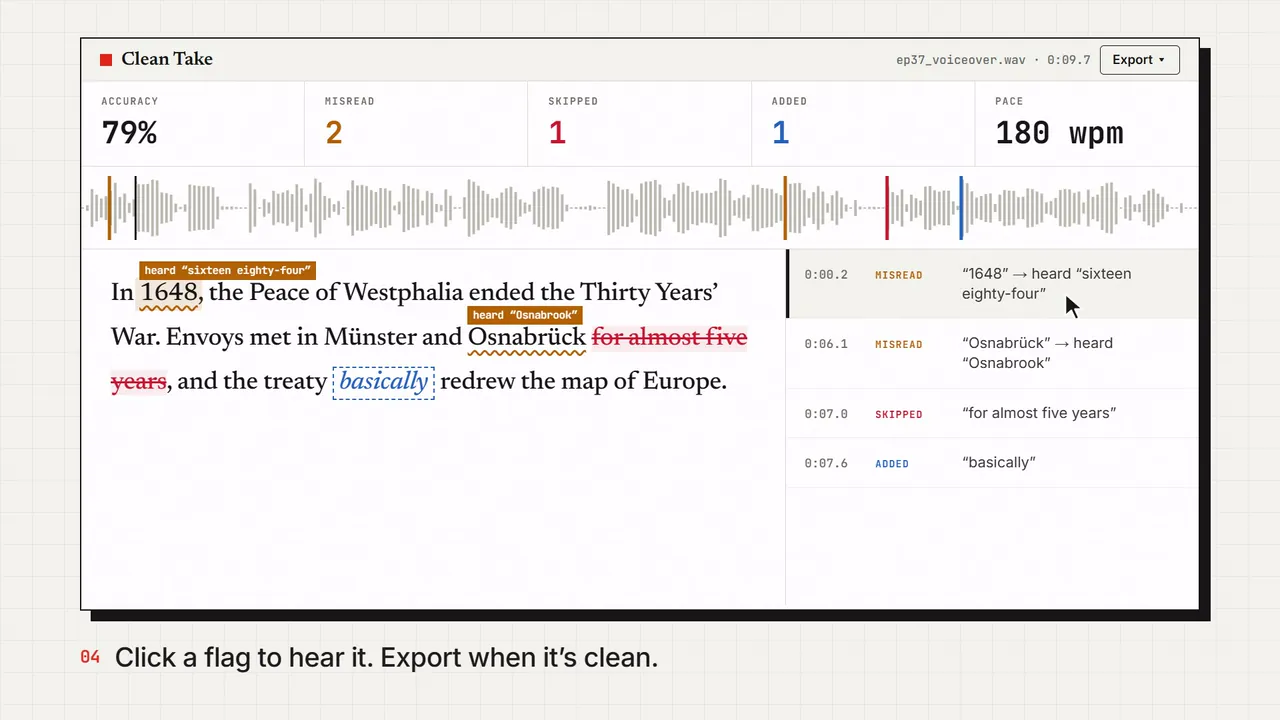
Clean Take · Voiceover checker for Windows
Catch every flubbed line before you publish.
Drop in your voiceover, yours or an AI voice, plus the script. Clean Take listens and marks every word that was skipped, added, or misread. Click one to hear the spot.
- Knows “1500” and “fifteen hundred” are the same thing
- Cuts your flubbed retakes and dead air, and keeps the last clean read
- Exports captions in your script’s spelling, timed to the take
- Runs on your PC. The audio never gets uploaded.
Windows 10 and 11 · Works offline · No subscription